BOQ Explained: What a Bill of Quantities Means When Building a House
Most homeowners planning a build in Zimbabwe encounter the phrase 'bill of quantities' early on: from a bank, an architect, or a contractor. Few get a clear explanation of what the document actually does, and fewer still understand its limitations. This guide explains what a BOQ is, how quantities are developed, what the document makes possible, and where its usefulness ends.
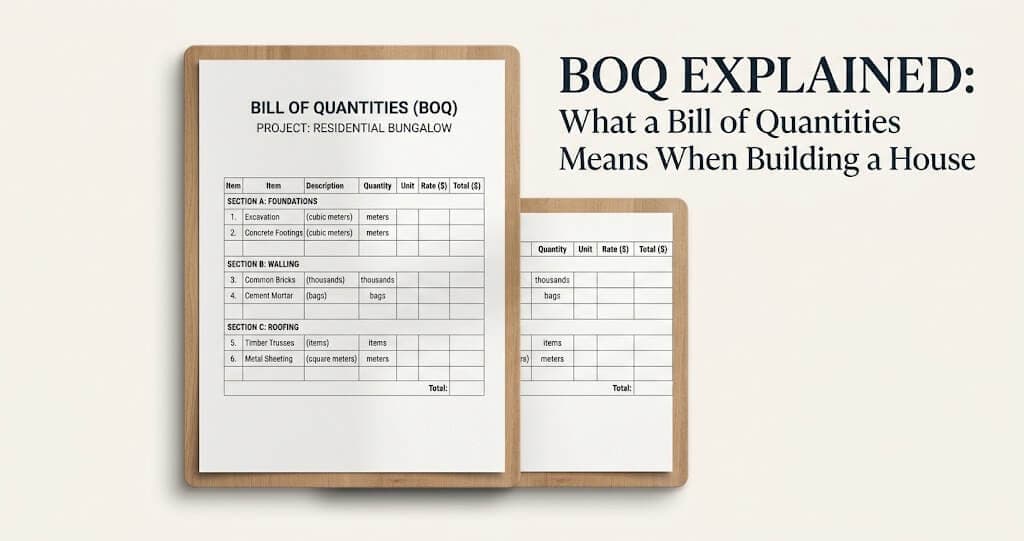
The letters BOQ appear early in most construction conversations in Zimbabwe. A bank asks for one before releasing finance. An architect mentions it when discussing fees. A contractor says they need one before they can price the job properly.
What the document actually is, and what it does and does not do, is explained far less often than it is referenced. This article covers the BOQ from a homeowner's perspective: what it contains, how it is produced, and what it cannot protect you from on its own.
What a BOQ Is, and What It Is Not
A bill of quantities is a measured document. It lists every element of a construction project in quantified units, section by section, so that anyone pricing the work is pricing the same thing.
Without a BOQ, two contractors quoting for a seven-room house may measure the brickwork differently, count the windows differently, and make different assumptions about the concrete specification. Their prices are not comparable because they are not describing the same scope. When a BOQ is used, both contractors price from the same quantities. The only meaningful difference in their tenders is then their rates: what they charge per unit of work.
A BOQ is a measurement document. It is not a price guarantee. It does not set the market rate for construction. It does not bind a contractor to a fixed price if conditions change. It does not prevent disputes on its own.
What it does is create a common language between the client, the designer and the contractor, and that common language is one of the most practical tools available for managing a construction project.
Where a BOQ Comes From
Who prepares it
In Zimbabwe, bills of quantities are prepared by quantity surveyors (QS). The Zimbabwe Institute of Quantity Surveyors (ZIQS), established in 1957, is the recognized professional body for the quantity surveying profession in Zimbabwe, and registered QS firms are listed on its register.
Architects sometimes prepare approximate quantities for early-stage budgeting. Contractors can and do prepare their own quantity schedules for internal pricing. But a formally prepared BOQ, particularly one required by a bank or used as a contract document, should be produced by a practitioner with quantity surveying qualifications and experience.
The Propertyzone cost guide reviewed by Dennis Nkomo puts the QS fee at 3 to 4% of total construction cost. On a US$75,000 residential build, that is US$2,250 to US$3,000 for the document that protects the client's budget and enables fair contractor comparison. Against the cost of a project that goes wrong, the QS fee is rarely the problem.
The standard method of measurement used for Zimbabwean construction BOQs is the system approved by ZIQS and the Construction Industry Federation of Zimbabwe (CIFOZ). This is the recognised framework for government and private sector construction measurement in Zimbabwe.
What it is taken from
A BOQ is taken off drawings. The quantity surveyor works through the approved building plans dimension by dimension: the length and height of every wall, the area of every floor, the volume of every concrete element, the length of every lintel, the area of every roof.
This process, called a quantity take-off, converts the architect's drawings into measurable quantities. A wall that is 8 metres long and 2.4 metres high becomes 19.2 square metres of brickwork. A footing that is 400mm wide, 300mm deep and 35 metres long becomes 4.2 cubic metres of concrete. Every element is treated this way.
The implication is important: a BOQ is only as accurate as the drawings it came from. If the drawings are preliminary or incomplete, the BOQ produced from them is an approximation, not a measured document. A BOQ produced from finalized, approved plans is a much more reliable pricing basis than one produced from a sketch or an early design.
What a BOQ Contains
A complete residential BOQ is organized into sections. Each section covers a different category of work or cost.
Preliminaries
The preliminaries section covers the costs of operating the site: setting up, managing, protecting and eventually clearing the site. Typical preliminary items include:
- Site establishment and security fencing during construction
- Construction of site offices or storage facilities if required
- Temporary electricity and water supply to the site
- Supervision and site management costs
- Insurance during construction
- Final site clearance and removal of temporary works
Preliminaries are real costs that are often invisible to a client reviewing a quote. A contractor who excludes preliminaries from their price may simply be including them elsewhere, or may have genuinely not allowed for them, which creates a risk of cost claims during the build.
Measured works
This is the main body of the BOQ. Measured works cover every quantified element of construction, organized by trade or construction element.
For a residential house, measured works typically include:
- Excavation (in cubic metres or linear metres, depending on type)
- Concrete works: footings, slab, ring beam, lintels (in cubic metres)
- Reinforcing steel (in kilograms or tonnes)
- Brickwork (in square metres or thousands of bricks)
- Roofing (in square metres, with specification of sheet type)
- Plastering (in square metres, internal and external)
- Floor finishes: screed or tiles (in square metres)
- Wall tiles (in square metres, by tile type and location)
- Joinery: door frames, window frames, doors (by item)
- Glazing (in square metres or by item)
- Electrical installation (by schedule or lump sum with specification)
- Plumbing and drainage (by schedule or lump sum with specification)
- Painting (in square metres, by number of coats and surface type)
- Gutters, fascias and downpipes (in linear metres)
Each item in the measured works section is described, quantified, and given a rate column for the contractor to complete. The sum of rate multiplied by quantity gives the total for that item. The totals roll up to a trade total, and the trade totals roll up to the summary.
Provisional sums and PC sums
Not every element of a project can be fully measured at BOQ stage. Where the design is not yet finalised or the work will be carried out by a specialist not yet appointed, the BOQ includes either a provisional sum or a prime cost (PC) sum.
A provisional sum is an allowance for work that is foreseen but not yet designed in enough detail to measure accurately.
A PC sum is an allowance for materials or work to be supplied by a nominated supplier or specialist subcontractor.
For more on how these items affect a construction quote comparison, see What Should Be in a Construction Quote in Zimbabwe?
Contingency and summary
A contingency sum is included to cover unforeseen costs during construction. It is an allowance for unknowns, not a contractor profit line. As the Propertyzone cost guide confirms using ZIMSTAT data, a minimum 15% contingency is appropriate in Zimbabwe's current construction environment given documented price volatility in both structural and finish materials.
The summary collects every section total, including preliminaries, measured works, provisional sums, PC sums, and contingency, into a single tender figure. This is the total price the contractor prices against and the figure the client uses for comparison.
What a BOQ Makes Possible
Fair comparison between contractors
This is the primary purpose of a BOQ. When every contractor prices the same measured quantities, the differences between tenders become visible and meaningful. A lower price is a lower rate for the same work, not a smaller scope hidden under a headline number.
Without a common BOQ, one contractor may include ceiling installation and another may exclude it, making a direct price comparison misleading. The BOQ removes that ambiguity by specifying exactly what is included.
A budget based on actual scope
An early estimate for a construction project, based on floor area and a rough cost per square metre, is a planning number. A priced BOQ from approved drawings is a project budget. The difference matters when a bank is lending, a family is committing savings, or a project is being managed across multiple months.
A site-specific, priced BOQ produced from approved drawings is the only reliable foundation for an actual project budget.
Protection against cost inflation during procurement
When a BOQ specifies materials by name, type and grade, the client has a reference point. If the contractor tries to substitute a lower-grade product at the same rate, the BOQ makes that substitution visible. The Government of Zimbabwe's own BOQ documentation requires written approval from the principal agent before any substitution of specified materials is accepted.
For a private client without that contractual protection explicitly in place, the BOQ still provides a reference document that makes the question of substitution discussable. A documented specification is better protection than an undocumented verbal agreement.
A reference for managing variations
When the scope of work changes during construction, and it almost always does to some degree, the BOQ provides the basis for pricing the change. A variation to add an extra bedroom can be measured and priced at the same rates used in the original BOQ. Without a BOQ, variation pricing becomes a negotiation with no anchor.
A requirement for construction finance
For any residential build funded by a Zimbabwean bank or mortgage lender, a priced BOQ is not optional. It is the document the lender uses to verify that the loan amount is grounded in a measured, realistic project cost. Without it, most lenders will not release funds.
What a BOQ Does Not Guarantee
It is only as good as the drawings it came from
A BOQ produced from a preliminary sketch contains provisional quantities based on incomplete information. As research on construction quantity methodology notes, if the quantity take-off is incomplete, based on outdated drawings, or measured from a design that has not been finalized, the BOQ inherits every one of those weaknesses. A BOQ prepared before the final floor plan is confirmed is an approximate budget, not a measured document.
This is why the correct sequence in Zimbabwe is: design, approve plans, then prepare the BOQ. A BOQ prepared before plans are approved should be treated as an early-stage budget estimate, not a construction price.
It does not mean prices will hold
A BOQ prepared in January 2026 reflected January 2026 prices. By September 2026, wall tiles tracked by ZIMSTAT's Building Materials Price Index (BMPI) had increased approximately 60% in USD terms compared to December 2022 levels. Diesel on the Civil Engineering Materials Price Index (CEMPI) rose more than 35% in a single month in March 2026 before partially easing.
A priced BOQ must include a validity period for the rates. If construction does not start within that validity window, the rates should be revisited. Using a BOQ prepared at old prices without checking current market rates is a common cause of budget shortfalls mid-build.
It does not replace a contract
A BOQ describes the scope and quantities. A contract sets out the terms under which the work will be done: how variations are handled, what happens when ground conditions differ from expectation, how disputes are resolved, and who carries which risk.
A signed BOQ is not a construction contract. For the project to be properly protected, the BOQ needs to be incorporated into a formal agreement signed by both client and contractor. For residential construction in Zimbabwe, the Agreement and Schedule of Conditions of Building Contract Suite, approved by the Institute of Architects of Zimbabwe (IAZ), ZIQS and CIFOZ, provides a recognized framework for that agreement.
It does not verify what is below ground
The BOQ measures what the drawings show. The drawings show what the designer knows. What the designer does not know at the time the drawings are prepared is what is underneath the ground: rock, unstable fill, high water table, or services crossing the site.
When excavation reveals conditions different from what was assumed, the original quantities may need to change. A BOQ on its own cannot anticipate ground conditions. The contractor's rates may also need to change if the method of excavation or the depth of founding changes as a result.
This is one reason why contingency remains important even when a BOQ is in place.
When to Get a BOQ
The right point to commission a BOQ is after your building plans have been prepared and are either approved or in a final state ready for submission. Commissioning a BOQ from a preliminary design gives you a planning estimate, which is useful for early-stage budgeting but should not be treated as a final project cost.
If you are applying for construction finance, you will need a BOQ from a recognized quantity surveyor before the bank will confirm the lending. Build this into your pre-construction timeline. A BOQ from a ZIQS-registered firm typically takes one to three weeks for a standard residential project, depending on its size and complexity.
If you are inviting more than one contractor to price your project, issuing a common BOQ to all of them is the most reliable way to get comparable tenders. If each contractor takes off their own quantities from the drawings, the comparison becomes much harder to read.
Need Help Coordinating the Pre-Construction Process?
Getting from approved plans to a priced BOQ to a contractor on site involves a defined sequence of professional and contractual steps. If you want support in managing that process or coordinating the scope of your project, NiceBuilt's project management service can help define what needs to happen and in what order.
For material supply and procurement coordination alongside construction, NiceBuilt's construction procurement service covers sourcing and supply-and-fix requirements tied to a defined scope.
Learn more about NiceBuilt's project management service
Sources
- Zimbabwe Institute of Quantity Surveyors (ZIQS). Organization profile and professional background. ziqs.co.zw. Established October 1957, active membership ~37 registered firms (2022 register). Address: No. 3 Conquenar House, 256 Samora Machel Avenue, Eastlea, Harare. Accessed September 2026.
- Government of Zimbabwe, Ministry of Local Government and Public Works. Bills of Quantities; standard documentation. ZIMRA tender annexure. Available at: zimra.co.zw. Uses the system of measurement approved by ZIQS and CIFOZ. Confirmed trade-name substitution requires written approval from the Principal Agent.
- Propertyzone (Fannuel Mirirayi, reviewed by Dennis Nkomo). "How Much Does It Cost to Build a House in Zimbabwe in 2026? A Real Cost Breakdown From Foundation to Completion." propzone.co.zw. Updated September 2026. For QS fee scale (3 to 4% of construction cost), ZIMSTAT CEMPI and BMPI index data, contingency guidance, material substitution risk, and BOQ as the only reliable foundation for a project budget.
- ZIMSTAT. Civil Engineering Materials Price Index (USD). Monthly reports, base January 2023 = 100. Data to July 2026. Zimbabwe National Statistics Agency, 2026. For diesel and structural material price movement data cited via Propertyzone above.
- ZIMSTAT. Building Materials Price Index (USD). Quarterly reports, base December 2022 = 100. Data to December 2025. Zimbabwe National Statistics Agency, 2026. For finish material price movement data (wall tiles +60%) cited via Propertyzone above.
- Buildern.com. "Bill of Quantities in Construction: Definition, Structure, and Usage." buildern.com. April 2026. For quantity take-off methodology, the distinction between measured and approximate BOQs, and the principle that a BOQ cannot outrun bad quantity input.
- Wikipedia. "Bill of Quantities." Wikimedia Foundation. Accessed September 2026. For the historical role of the BOQ and its function in creating a fair tendering basis.
- Titan Law (Tariro Mafa). "The Construction Industry in Zimbabwe: Benefits of Using Standard Forms of Contracts in the Zimbabwean Construction Industry." titanlaw.co.zw. 27 May 2024. For the Agreement and Schedule of Conditions of Building Contract Suite (IAZ/ZIQS/CIFOZ) as the standard residential contract form.
Share your details and we'll respond within 2 business hours.