What Should Be in a Construction Quote in Zimbabwe?
When two contractors quote different prices for the same house, the difference is rarely because one contractor charges more for the same thing. Usually, one quote covers more and one covers less. This guide explains what a construction quote in Zimbabwe should contain, which elements carry the most financial risk, and how omissions rather than outright errors are the most common cause of budget disputes.
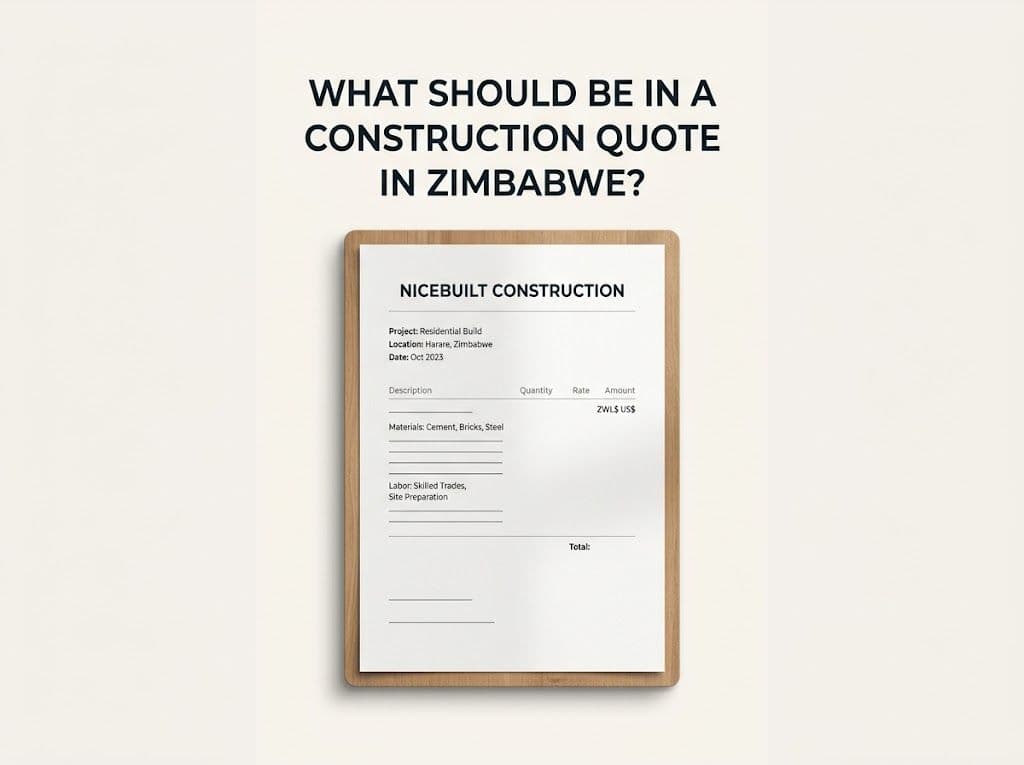
Comparing construction quotes is harder than it looks. A quote that is US$15,000 cheaper than its nearest competitor is not necessarily better value. It may simply describe less work.
The most common source of budget overruns on Zimbabwean residential builds is not dishonest contractors inflating prices mid-build. It is incomplete quotes that both parties interpreted differently. The contractor knew their quote excluded external plastering, ceiling installation and the perimeter wall. The homeowner assumed these were included because the contractor said they would build the house.
This guide explains what a residential construction quote in Zimbabwe should contain, how to identify what is missing, and what the different terms actually mean when a contractor uses them.
A Quote and a Scope Are Not the Same Thing
A quote is a price. A scope is a description of what the price covers.
A contractor can hand over a single number, "Build a 7-room house for US$38,000," and call it a quote. What they cannot reasonably call it is a complete scope of work. Without a scope, there is no shared understanding of what the number includes.
A complete construction quote describes:
- What work will be done
- How much of each material will be used
- Which materials are specified
- What the labour rates cover
- What is not included
- When payments are due and at which stage
- How long the quote price is valid
- How changes to scope will be handled
A quote that omits any of these elements is an incomplete document. That does not always mean the contractor is acting in bad faith. It often means they have quoted quickly for a conversation, not for a project. The problem begins when a project is priced from that incomplete document.
What the Scope of Work Must Cover
The full building description
The scope should identify the building by reference to the approved plans. A quote based on drawings is more reliable than a quote based on a verbal description of room count.
The relevant details include:
- Number of rooms and their function
- Total floor area in square metres
- Number of storeys
- Wall construction type (brick, block)
- Foundation type (strip footing, pad footing)
- Floor type (concrete slab, suspended slab)
- Roof type (IBR sheeting, tiles, Chromadek)
- Ceiling type where applicable
- External finishes (plaster, paint)
- Internal finishes (tiles, screed, paint)
A quote that describes the project only as "a 7-room house" is using a shorthand that can mean almost anything. The same number of rooms can produce very different scopes depending on floor area, layout complexity and finish specification.
Quantities
A properly prepared quote lists quantities in measurable units. The key quantities for a residential build include:
- Brickwork in square metres or thousands of bricks
- Concrete in cubic metres (footings, slab, ring beam)
- Reinforcing steel in kilograms or tonnage
- Timber in linear metres or cubic metres
- Roofing sheets in square metres
- Plastering in square metres
- Tiling in square metres and by tile type
- Painting in square metres and by coat
When quantities are absent, the client has no basis for checking whether they received what they paid for. They also have no basis for assessing why a quote is cheaper or more expensive than another.
Materials specified by name, grade and source
"Good quality materials" is not a material specification. A complete quote identifies materials by:
- Product name or type (e.g. Portland cement, IBR 0.47mm, ceramic tiles 600x600)
- Grade or specification where relevant (e.g. deformed bar Y12 at 200mm centres)
- Source or approved equivalent where a substitute may be used
Material specification matters in Zimbabwe because the gap between a specified product and its substituted equivalent is often significant. Wall tiles on the ZIMSTAT Building Materials Price Index rose approximately 60% in USD between December 2022 and December 2025. When a budget is set against one tile and installed with another that costs a fraction of the price, the saving goes to the contractor, not to the client.
The Propertyzone construction cost guide reviewed by Dennis Nkomo identifies material substitution as the most common failure mode on builds where the client is not on-site daily. The solution is a quote that specifies materials with enough detail that substitution would be visible.
The Terms That Change the Total Price
Provisional sums
A provisional sum is an allowance included in the quote for work that is foreseen but cannot yet be accurately priced because the design or specification is not yet finalised.
For example, if a client wants an unusual kitchen layout but has not yet finalised the design, the contractor may include a provisional sum of US$3,000 for kitchen joinery. When the kitchen design is finalised, the actual cost replaces the provisional sum. If the actual cost is US$5,000, the client pays an additional US$2,000 on top of the quoted figure.
Provisional sums are legitimate. Construction projects frequently involve elements that cannot be fully scoped at quote stage. The risk is a quote that contains many large provisional sums while presenting a headline figure that looks competitive. The headline figure is then replaced by a much larger number as actual costs are confirmed.
A well-managed quote keeps provisional sums to a small proportion of the total. For context, guidance from the New Zealand Government Procurement Office suggests limiting provisional sums to no more than 5 to 10% of the total contract sum where possible. Higher proportions signal an under-developed scope and more financial uncertainty for the client.
When you receive a quote with provisional sums, ask what each allowance covers and what the range of actual cost might be.
Prime cost (PC) sums
A prime cost sum is an allowance for materials or work that will be supplied by a nominated supplier or specialist subcontractor, not sourced by the main contractor.
Typical PC items in a Zimbabwean residential build include:
- Sanitary ware (basins, toilets, showers)
- Kitchen cupboards
- Electrical fittings and light fittings
- Door handles and locks
- Tile specification above a standard grade
The contractor installs the PC item but does not supply it. The client selects and purchases it, or the contractor purchases it against a fixed allowance. If the client selects sanitary ware that costs more than the PC sum allowed, the difference is an additional cost.
A quote that lists PC sums without naming the assumed allowance level gives the client no useful budget information. Always ask what allowance is included for each PC item.
Contingency
A contingency is an amount included in the quote to cover unforeseen events and conditions during construction. It is not a profit line. It is a financial buffer against ground conditions, weather, material price movements and site discoveries.
In Zimbabwe's current construction environment, a 15% contingency is the minimum that makes practical sense, not a comfortable buffer. The Propertyzone construction cost guide notes that the Civil Engineering Materials Price Index (CEMPI) rose more than 6% in a single month in March 2026 driven by diesel. A contingency that cannot absorb a significant movement in a single material category is not adequate protection.
A quote that contains no contingency line is either embedding it invisibly in the rates (which makes the scope impossible to check) or not allowing for it at all. Both create risk for the client.
Exclusions: The Section That Changes the Comparison
This is where most quote disputes originate.
Exclusions are items that are not covered by the quoted price. A contractor is not required to include every element of a project in a single quote. What they are required to do, for the quote to be useful to the client, is to state clearly what they have left out.
The following items are commonly excluded from residential construction quotes in Zimbabwe without being explicitly flagged:
External works:
- Perimeter wall and gate
- Driveway and paving
- Landscaping and levelling beyond construction scope
Services:
- Borehole (where no municipal water is available)
- ZESA connection and supply
- Septic tank or bio-digester (where no sewer connection)
- Solar system
Finishes that may be separately quoted:
- Ceiling installation (often a separate subcontract)
- External painting
- Gutters and downpipes
- Security features including burglar bars and gate motors
Preliminary and associated costs:
- Professional fees (architect, structural engineer, quantity surveyor)
- Council plan approval fees and inspection fees
- Certificate of Occupation fees
- Transport of excavated material off-site
- Temporary fencing and site security during construction
- Clean-up and removal of construction waste
Material supply versus labour only: A quote that covers labour only and assumes the client supplies all materials is a very different document from a supply-and-fix quote. The payment structures are different. The risk of material shortages falls differently. If the contractor's rate is lower because they are not managing procurement, the client inherits a procurement role they may not be equipped for.
The difference between a comprehensive supply-and-fix quote and a labour-only quote can account for a significant portion of what looks like a price gap between contractors.
When comparing two quotes, list every exclusion from each and rebuild the comparison on the basis of what each one actually delivers.
Payment Terms
How payments are structured has a direct effect on who carries the financial risk during construction.
The main approaches used in Zimbabwean residential construction:
Milestone-based payments
The client pays a defined amount when a construction stage is verified as complete. Common milestones include:
- Mobilisation: a deposit paid before work begins
- Foundations and slab: payment on verification of completed concrete work
- Wall plate: payment when brickwork reaches wall-plate level
- Roofing: payment when the roof is on and structure is weathertight
- Plastering: payment on completion of internal and external plaster
- Practical completion: final payment on handover
Milestone payments protect both parties. The contractor is paid as they progress. The client does not pay in full before the work is done.
Front-loaded payments
A quote that requires 60% or more of the contract sum before substantive work begins transfers most of the financial risk to the client. If construction stalls after mobilisation, the client's recourse is through the courts, which is slow and uncertain.
A reasonable deposit for mobilisation and early material procurement on a residential build is typically in the range of 20 to 30% of the contract sum. Larger upfront payments require a very clear written agreement on what they cover and what protection the client has if work does not proceed.
Calendar-based payments
Payments triggered by dates rather than verified stage completions give the contractor an incentive to receive payment regardless of progress. A properly drafted contract must link payment milestones to verified stage completions, not calendar dates.
Retention
Retention is a percentage of each payment, typically 5% to 10%, that the client withholds until the end of the defects liability period. The purpose is to give the contractor a financial reason to return and fix defects after practical completion. Under the standard building contract forms recognised in Zimbabwe, a defects liability period of 6 to 12 months following practical completion is normal.
A quote that does not address retention is not necessarily unusual for a smaller residential build in Zimbabwe. But a client who accepts a quote with no retention provision accepts less contractual protection against defects that appear after the contractor leaves.
Programme
A construction programme is a schedule showing which construction stages are planned for which periods. A quote without any programme is harder to evaluate than one that includes a planned sequence.
The programme matters for two reasons. First, it tells the client whether the timeline is realistic given the scope. Second, it makes delays visible. If the programme says roofing should be complete in week ten and it is week fourteen, there is a documented basis for discussion.
For background on how the construction stages sequence and what realistic timelines look like for a residential build in Kadoma, see How Long Does It Take to Build a House in Kadoma?
Price Validity
Material costs in Zimbabwe move. A quote prepared today may not reflect market conditions in three months' time.
As the Propertyzone cost guide notes, diesel spiked more than 35% in a single month in early 2026 before partially easing. Any cost schedule that does not specify a validity period leaves both the client and the contractor exposed if time passes before the project starts.
A responsible quote states how long the prices are valid. Thirty to sixty days is common. Anything longer than ninety days in the current construction environment should be treated with caution unless the contractor has confirmed forward pricing on the major materials.
If significant time passes between a quote being issued and work beginning, ask for a revised quote before signing a contract.
Standard Contracts Used in Zimbabwe
For residential construction in Zimbabwe, there are recognised standard contract forms that provide a structured framework for managing scope, payment, variations, disputes and completion.
The Agreement and Schedule of Conditions of Building Contract Suite is the main standard residential contract used in Zimbabwe, approved by the Institute of Architects of Zimbabwe (IAZ), the Zimbabwe Institute of Quantity Surveyors (ZIQS) and the Construction Industry Federation of Zimbabwe (CIFOZ). Under this form, an architect serves as the principal agent, administering the contract on behalf of the client.
The NJPC 2000 Contract is another commonly used form. For public sector projects, the Zimbabwean Procurement and Construction (ZPC) Contract applies. FIDIC and NEC contracts are also used on more complex or internationally funded projects.
Standard contracts provide defined terms for:
- How variations to scope are priced and approved
- What happens when unforeseen conditions are discovered
- How payment certificates are issued and disputed
- What the defects liability period covers
- How disputes between client and contractor are resolved
A typed quote on a sheet of paper, or a WhatsApp message with a total price, is not a contract. For any project of significant value, the advice of a qualified quantity surveyor or construction professional on an appropriate contract form is worth the cost.
A Checklist for Reading a Construction Quote
Before accepting a quote, confirm that you have clear answers to the following:
Scope:
- Is the work described by reference to approved drawings?
- Are the key elements listed: foundation type, wall type, roof type, floor, ceiling, finishes?
- Is floor area in square metres stated?
Quantities and materials:
- Are quantities listed in measurable units?
- Are materials specified by name, grade and type?
- Does the quote distinguish between supply-and-fix and labour-only rates?
Financial terms:
- Are provisional sums identified separately and individually described?
- Are PC sums identified and their allowance levels stated?
- Is a contingency sum included?
- Is there a price validity period?
Exclusions:
- Is there an explicit exclusions section?
- Have you checked whether ceiling, external works, perimeter wall, paving, solar and services connections are included or excluded?
Payment:
- Are payments linked to verified construction stages rather than calendar dates?
- Is the deposit amount and what it covers clearly stated?
- Is there a retention arrangement for defects?
Programme:
- Is there a construction programme or planned completion date?
Contract:
- Is there a written agreement signed by both parties before work begins?
- Does the agreement address variations, delays and defects?
Need Help Defining the Scope of Your Project?
Understanding what a quote should contain is only the first step. The harder task is defining the scope clearly enough that every contractor is pricing the same project.
NiceBuilt's project management service works with clients to clarify the scope of their construction projects, coordinate the stages of work, and manage progress against an agreed programme. If you have received quotes that are difficult to compare, or if you want to ensure your project is properly scoped before you go out to tender, talk to the team.
Learn more about NiceBuilt's project management service
Sources
- Titan Law (Tariro Mafa). "The Construction Industry in Zimbabwe: Benefits of Using Standard Forms of Contracts in the Zimbabwean Construction Industry." titanlaw.co.zw. 27 May 2024. For Zimbabwe standard contract forms (IAZ/ZIQS/CIFOZ Agreement and Schedule of Conditions, ZPC, NJPC 2000, FIDIC, NEC).
- DLA Piper Real World. "Construction and Payment in Zimbabwe." dlapiperrealworld.com. Accessed September 2026. For Zimbabwe contract law, defects liability, Prescription Act [Chapter 08:11], Certificate of Occupation requirements.
- Propertyzone (Fannuel Mirirayi, reviewed by Dennis Nkomo). "How Much Does It Cost to Build a House in Zimbabwe in 2026? A Real Cost Breakdown From Foundation to Completion." propzone.co.zw. Updated September 2026. For ZIMSTAT CEMPI and BMPI material price data, contingency guidance, material substitution risk, payment milestone advice.
- IntoAEC.ai. "What is BOQ in Construction?" intoaec.ai. July 2026. For BOQ section definitions: preliminaries, measured works, provisional sums, PC sums, contingency, dayworks, summary.
- Zimbabwe High Court. Case HH 106-2003 (HC 10682/2000). ZimLII, 22 July 2003. zimlii.org; for documented Zimbabwe residential construction dispute arising from inadequate contract terms, delayed completion, and defects in plastering, painting, frames and plumbing. Referenced for qualitative illustration only; monetary figures are in pre-hyperinflation Zimbabwean dollars and not reproduced.
- New Zealand Government Procurement. "Lump Sum Contract: Information Sheet." procurement.govt.nz. Accessed September 2026; for benchmark guidance on provisional sum limits (5 to 10% of total contract sum).
- ZIMSTAT. Civil Engineering Materials Price Index (USD), July 2026 data. Zimbabwe National Statistics Agency. For material price movement data cited via Propertyzone above.
Share your details and we'll respond within 2 business hours.